
Did the Oilers Have Too Many Legends at the Same Time?

The Edmonton Oilers don’t really do “simple” history. Most franchises can point to a best player at each position and have a reasonable argument to back it up. But the Oilers have an oddly good problem. The team can stack legends on top of legends until the whole exercise starts to feel less like ranking and more like trying to separate waves in a storm that all broke at once.
Building a Franchise Four for the Oilers Is Difficult.
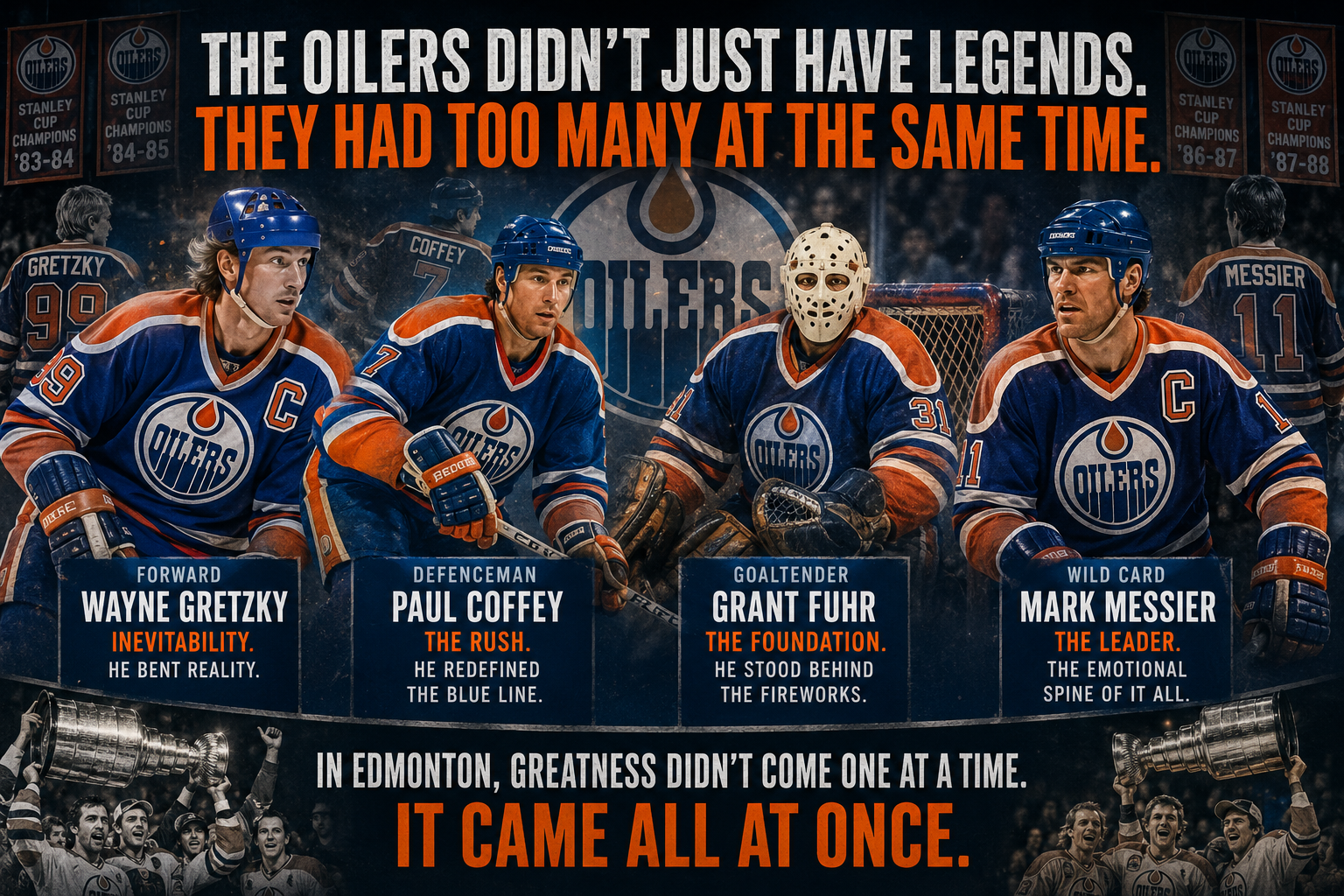
So when you try to build a “Franchise Four” by position for the Oilers—one forward, one defenceman, one goaltender, and a wild card—you’re not really identifying greatness. You’re deciding which version of it you’re willing to live with.
The Oilers have had two great forwards.
Up front, there’s Wayne Gretzky, and the conversation almost stops there. Not because Connor McDavid doesn’t belong in the same breath, but because Gretzky represents something heavier than production. He represents inevitability. The puck didn’t follow him so much as arrive before everyone else realized it was supposed to move.
McDavid, in his own way, feels like the modern echo of that same inevitability. He works in a faster, more compressed game. Two eras, same sensation: Edmonton has always had forwards who bend reality toward them.
Related: Oilers' Nurse to Penguins? Don't Underestimate the Dubas Factor
The Oilers’ great defenceman was Paul Coffey.
On defence, Paul Coffey is the reminder that the Oilers once turned blue lines into launch pads. He wasn’t just a defenceman joining the rush—he was the rush. In most franchises, that kind of offensive dominance would stand alone. In Edmonton, it became part of the system, almost normal. What Coffey did was redefine what “defenceman” meant in an era when the game still thought in straight lines.
The greatest Oilers’ goalie was Grant Fuhr.
In goal, Grant Fuhr sits as the quiet contradiction to all the noise in front of him. The Oilers of the 80s were fireworks; Fuhr was the net behind them that had to survive the aftermath. His numbers, his workload, his championships—they tell the story of a goalie who didn’t just play behind a dynasty, but absorbed its chaos and kept it intact long enough for the next Cup run to arrive.
The Oilers’ wild card was one of their best leaders, Mark Messier.
And then there’s Mark Messier—the emotional spine of it all. Leadership in Edmonton has never been abstract. It has a face, a voice, and usually a weight that changes the room the moment it enters.
Is it a problem that the Oilers had almost too many great players to go around?
That’s the real tension in Edmonton’s history. It isn’t choosing greatness. It’s realizing how many different kinds of greatness lived there at the same time—and how impossible it is to separate one without diminishing the others.